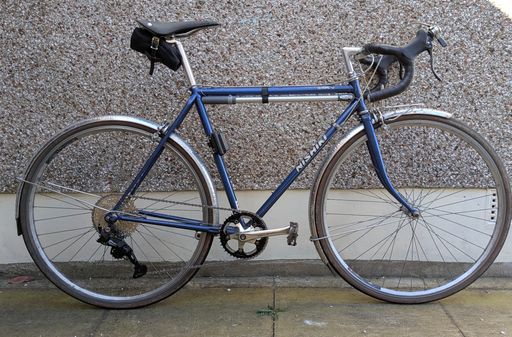
I have never had a proper drop-bar groupset. There, I said it. It’s a hangover from way back, when I put together a CX bike and wanted a 1× drivetrain that didn’t then exist. It has carried on since then because I am both cheap and contrary. Shimergo and Sramergo are how I roll.
It’s been a mixed bag. The Trailblazer was flawless from the start: Campag shifters, Sram derailleur, Shimano 10-speed cassette, and it snicks up and down the gears without any fuss. The Nishiki Olympic 12, on the other hand, was balky and jittery with the exactly the same components. I quickly switched to a 9-speed Shimergo setup, although as the gear cable housing wore out, I found myself routinely over- and under-shifting to get into the gear I wanted. It got in the way, which is the last thing you want from a shifter.
So, how to improve the shifting on the Nishiki? I could replace the cable housing, which would work until it didn’t any more. I could replace the groupset, maybe with Microshift’s 1×9 Sword Black or Shimano’s 1×8 Essa or 1×9 Cues, to at least start from a point where all of the components worked properly together. Of course, these would all eventually hit the same problem: the cable housing wears, the indexing goes off. I even thought about piecing together an electronic groupset – perhaps a minimal setup with only a derailleur and some blip shifters – which would solve the cable wear problem, although at a hefty price.
But there is another way: ✨friction shifting✨. With a friction shifter, you can swipe up or down the cassette in a single motion, faster even than Di2 or AXS. Most friction shifters are cheap. You can mix and match drivetrain components with abandon, since there aren’t any fixed indexing points to worry about. And, crucially, you can easily trim out wear in the system. Friction was the way.
The thing was, I didn’t know where to put a friction shifter. I didn’t want it on the down tube, because this isn’t 1989 any more.1 A thumb shifter on the tops would have been an option, although I’d have to widen the clamp to fit road bars. Bar-end shifters made a lot of sense, but, honestly, I did not like the anorak energy that comes with them.
The only other options were Equal’s supremely cool Growtac Control levers, which put a friction shifter inside a brifter, or Gevenalle’s more agricultural versions, which put a friction shifter on the outside of a drop-bar brake lever. Either would have worked, but both were so expensive as to make AXS look almost reasonable.
Could I … could I cheat instead? The internet seemed to think so.
This thread at Singletrack was my inspiration: I would make a Gevenalle shifter. I bought an Sunrace friction thumb shifter for £22 plus postage, pulled a pair of unused Tektro RL340 brake levers out of the spares box, and got to work with a hacksaw, a file and a drill. It took only a few hours to pull it all together like this:
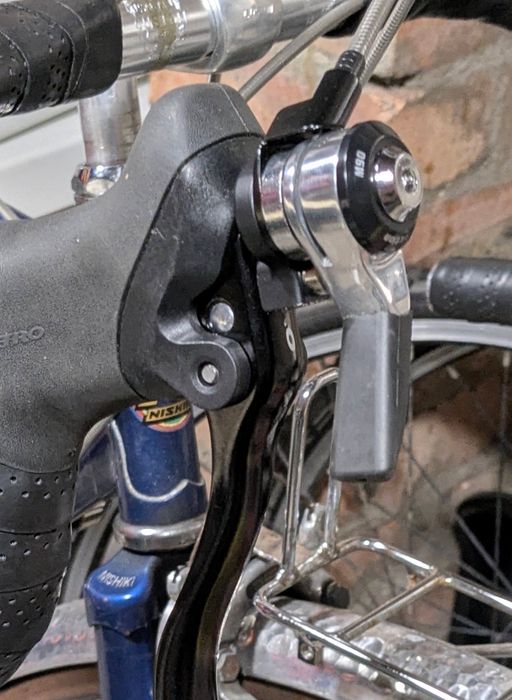
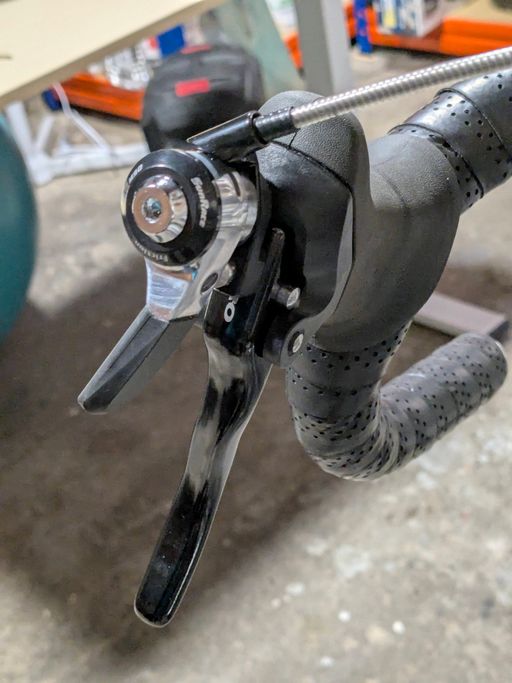
And: it worked. Really, really well. I’d worried about the ergonomics of a shifter bolted to the front of a brake lever. I’d worried about friction shifting being a bit crap. But neither was true. It’s easy to shift from the hoods, including those massive cassette-dumps to get into an easier gear. And modern cassettes and derailleurs are so good that the shifter almost seems to find the gears itself. If the chain is making a noise, it’s because I didn’t shift properly, not because I need to start playing with barrel adjusters.
Shifting does now take a bit of attention to make sure the gear is trimmed properly. It’s not quite as quick as a brifter either – there’s a little more planning ahead for gear changes than there used to be, although being able to dump the entire cassette as I roll up to a red light makes up for it. Perhaps the best thing I can say for it is that even after only a few weeks, I’m already in the groove. I don’t notice the shifter-wart on the brake lever, and I don’t notice the marginal extra work it takes to use it.
All in all, shifting was light and predictable and rewarding, so of course I had to change it.
I’d switched from dry to wet lube over the winter, which bought a quieter drivetrain at the cost of a permanent oil stain on my trousers. Cleaning the bike was a pain, too, because the sticky winter lube held onto more dirt than the waxy summer lube. Perhaps because of that extra dirt, my old Deore derailleur’s sprockets were worn almost into throwing stars.
So, part two of the plan: clean the still-newish chain on the bike until it was spotless; replace the derailleur and cassette with new ones; and then wax and reinstall the chain.
Chain waxing was new to me. The idea is that you immerse the chain in molten paraffin wax until it has penetrated into the rollers, then take it out of the wax and let it cool. When you reinstall it, you have a lubricated but oil-free chain. (No more oil on the trousers, in other words.) There are professional-grade waxes and heaters out there, but there’s also a vocal DIY minority which swears you can do it with a slow cooker and a bag of candle wax. I did it with a pot of water on the hob and a sacrificial Pyrex bowl, and it seemed easy enough. The worst part was cleaning the chain beforehand; it has to be absolutely spotless so that the wax doesn’t just bind contaminants onto the chain rollers. I must have used a litre of degreaser.
I paired the chain with an Essa derailleur and a secondhand 9-speed, 11-40 Sunrace cassette. Shimano’s Essa is intriguing. It’s a budget wide-range 1×8 system intended to consolidate Shimano’s older groupsets, which means it shares a pull ratio with more or less every pre-10-speed Shimano group: Altus, Acera, Tourney, Claris, Alivio, Deore, Sora and 105. (I’m sure I’m forgetting some.) This means the Essa derailleur, which can shift a 45-tooth cassette, is like a skeleton key for cheap-ass wide-range drivetrains. Got a low-end Shimano groupset? Hook it up to an Essa derailleur and throw on that dinner-plate cassette.
What it also means is that I was able to pair an Essa derailleur with my old-school friction shifter and a wide-range 9-speed cassette. I’d planned to use a Sram derailleur from my parts bin when I first installed the shifter, but it didn’t pull enough cable to cover the entire cassette – the Sunrace M90/M96 seems to be tailored to Shimano’s older 1.7:1 ratio, but modern derailleurs need more cable pulled per click. Essa, of course, still uses that old ratio, so the shifter had no problems with it. Worth bearing in mind if you want to try the same thing I did.
And, again, it worked! The chain sheds a bit of wax dandruff and runs a little louder than with the wet lube, but the drivetrain shifts well and it’s that bit easier to get up the big hills. All in all, It has been an epiphany of sorts for me – a way to set up and maintain a drivetrain with less fuss, less mess and less money.
I moved the Olympic 12’s bell from the bars to the spare downtube boss a while back, and it turned out to be a bad idea. It looks good; it is awful to use. ↩︎